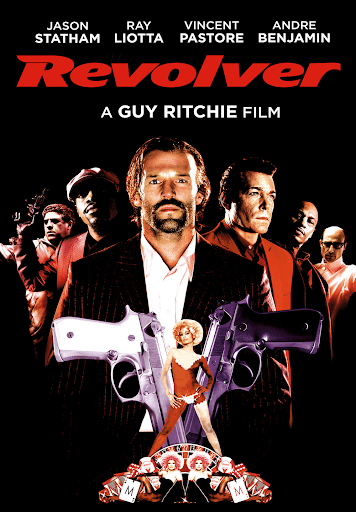
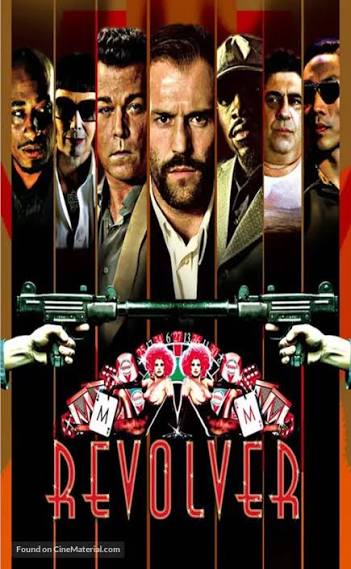
Revolver, Guy Ritchie’s 2005 film presents itself as a crime thriller, filled with gangsters, casinos, money, revenge, manipulation, and elaborate schemes, but beneath that familiar surface lies something far stranger. It uses the language of the gangster film to explore something much more abstract about invisible forces that govern us.
This is perhaps why Revolver has always been such a divisive film. Some viewers may look it as overcomplicated and pretentious attempt by becoming a philosophical. Some others, it is one of the most ambitious and misunderstood films of his career. Both reactions contain some truth. Its narrative can feel deliberately obscure, and its symbolism occasionally seems to announce itself rather than emerge naturally from the story. Yet beneath all of this is a genuinely compelling question: what if the greatest enemy in our lives is not the person standing against us, but the part of ourselves that constantly insists we must fight?
At first glance, the film tell a fairly conventional story of revenge. Jake Green, played by Jason Statham, is released from prison after spending seven years behind bars. He emerges from that experience with a reputation for being intelligent, dangerous, and almost impossible to defeat. His past, however, is tied to Dorothy Macha, a powerful and volatile casino owner played by Ray Liotta. Jake’s imprisonment was connected to a gambling game designed to humiliate Macha, and when Jake returns to the world outside prison, the old conflict remains unresolved.
The ingredients are familiar. An insult that must be answered, an enemy who must be defeated, money that must be acquired, and a dangerous world in which everyone appears to be manipulating everyone else. On the surface, this is the sort of material Guy Ritchie had already explored successfully in Lock, Stock and Two Smoking Barrels and Snatch. But Revolver immediately feels different. Those earlier films were primarily concerned with the pleasure of the game. Their characters were constantly scheming, bluffing, and attempting to outsmart one another, and much of the entertainment came from watching the machinery of the plot operate.
In Revolver, however, the game itself is suspicious. The characters are still playing games, but the film increasingly asks why they are playing them at all. Why does Jake need revenge? Why does Macha need to be feared? Why do people who already possess wealth and power continue to pursue more of it? Why does humiliation matter so much? Why does winning never seem to provide the peace that the characters expect it to provide?
These questions gradually transform Revolver. Jake believes that his problem is the existence of enemies. If he can defeat them, he will finally be free. Yet the film begins to suggest that this way of thinking may itself be the trap.
Jake Green is an interesting protagonist because his greatest strength is also his greatest weakness. He is intelligent, observant, and capable of recognising the weaknesses of other people. He understands the logic of manipulation. He knows that people can be controlled through fear, pride, greed, and the desire to appear powerful. But like many intelligent people, Jake seems to believe that understanding manipulation makes him immune to it.
This is one of the film’s most interesting psychological ideas. We often assume that the person who understands the game cannot be controlled by the game. But intelligence can easily become a trap of another form of ego. A person can become attached to the identity of being the person who sees through everyone else. The need to be clever becomes a weakness. The desire to prove that one cannot be fooled creates a vulnerability to anyone who understands that desire.
Jake’s identity is built around the belief that he is not someone who can be defeated. This belief is not merely confidence. It is something much more fragile. He needs to be intelligent because he is afraid of being made to look foolish. He needs to be strong because he is afraid of weakness. He needs revenge because humiliation has wounded the image he has constructed of himself.
This is where Revolver begins to shift beyond the traditional revenge story. Revenge is usually presented as a form of justice or emotional resolution. Someone has been harmed, and the desire to retaliate appears to offer a path toward restoration. But revenge rarely restores what has been lost. More often, it keeps the original injury open.
The person who has been humiliated becomes psychologically attached to the humiliating event. The enemy remains present in the mind long after the original confrontation has ended. Every act of revenge continues to revolve around the person one claims to hate. In this sense, hatred can become a form of attachment. The enemy occupies the mind, determines one’s actions, and gives meaning to one’s existence.
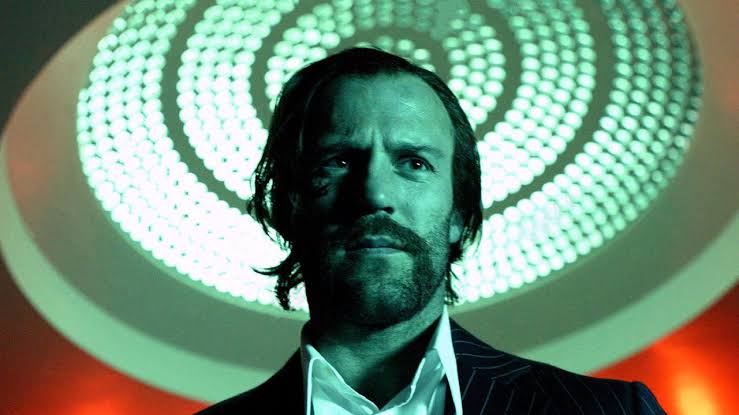
Jason Statham is particularly interesting in this role because Jake Green initially appears to be a familiar Statham character. A cool, confident, physically capable, and apparently in control. But Revolver gradually undermines this image. Jake’s confidence begins to feel less like certainty and more like armor.
The performance is quieter than many of Statham’s later action roles. The character is not simply a man who knows what to do. He is a man whose confidence is slowly being challenged. The more he learns, the less certain he becomes about the structure of the world around him.
This uncertainty is important because the film itself is designed to produce a similar feeling in the audience. We are accustomed to crime films in which the rules eventually become clear. We may not know who will win, but we understand the nature of the game.
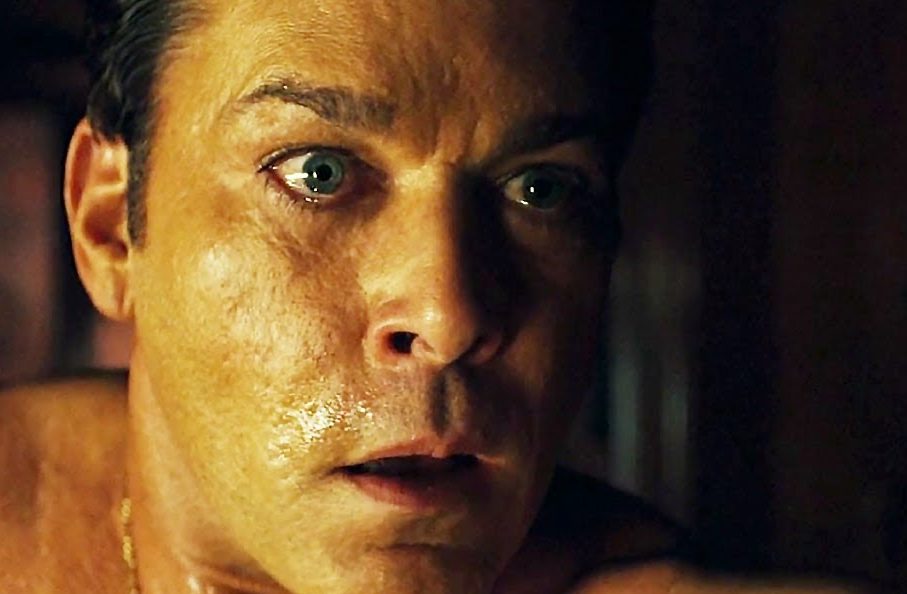
Ray Liotta plays Dorothy Macha, as a man who is constantly performing his own power. Macha is theatrical, violent, and unpredictable, but beneath the performance is a profound fear of humiliation. He does not simply want to be powerful. He needs other people to believe that he is powerful.
From them the performances become essential. Jason Statham gives us a man desperately holding together an identity, while Ray Liotta on the other hands portrays what happens when that identity becomes all a person has left.
Perhaps the film’s most surprising performances belong to André Benjamin and Vincent Pastore as Avi and Zach. Introduced as intimidating loan sharks, they gradually become something far more difficult to categorize. Unlike the other criminals populating the film, Avi and Zach possess an almost unsettling calm. They rarely raise their voices, rarely display unnecessary aggression, and never seem particularly interested in proving themselves. Their confidence does not resemble Macha’s carefully maintained performance; it feels quieter, almost detached. André Benjamin, in particular, gives Avi an unusual serenity that distinguishes him from every other character on screen. His measured delivery and composed demeanour suggest someone who understands the rules of the game but no longer feels compelled to participate in it emotionally.
This calmness gives Avi and Zach an almost mythical quality. Depending on how one interprets Revolver, they can be viewed simply as experienced criminals, as mentors guiding Jake or even as symbolic manifestations of wisdom itself. The film deliberately leaves room for all three readings.
Similarly, Mark Strong’s Sorter leaves a memorable impression despite his restrained appearance. Long before Strong became known for portraying intelligent and quietly intimidating antagonists, Revolver allowed him to explore many of the qualities that would later define his career. Sorter is methodical, disciplined, and almost mechanical in his efficiency. Unlike Macha, he wastes no energy on theatrical displays of dominance. Yet there is something unsettling about this professionalism.
Taken together, these characters transform Revolver into something richer than an elaborate crime story. Rather than existing solely to advance the narrative, they function as mirrors reflecting different responses to the same underlying condition. Jake seeks freedom through understanding. Macha seeks safety through domination. Avi and Zach pursue clarity through detachment. While Sorter finds comfort in mastery without reflection. Each occupies a different position within the same psychological landscape, and each reveals another way in which fear shapes human behaviour.
Guy Ritchie earlier films were usually criminal schemes. One character makes a mistake, another person tries to exploit it, and the consequences move through the network of relationships like a chain reaction. In Revolver, its greatest mechanism is the human mind. The characters are not simply being manipulated by other people but also by their own desires. They believe they are making choices, but many of those choices are illusion. Even their identity is a prison.
And this why, at least for me, Revolver becomes much more than a conventional crime thriller, But more a philosophical one.
“There is something about yourself that you don’t know. Something that you will deny even exists until it’s too late to do anything about it. It’s the only reason you get up in the morning, the only reason you suffer the shitty boss, the blood, the sweat and the tears. This is because you want people to know how good, attractive, generous, funny, wild and clever you really are. “Fear or revere me, but please think I’m special.” We share an addiction. We’re approval junkies. We’re all in it for the slap on the back and the gold watch. The “hip, hip, hoo-fucking-rah.” Look at the clever boy with the badge, polishing his trophy. Shine on, you crazy diamond. Cos we’re just monkeys wrapped in suits, begging for the approval of others
Final Thoughts — Spoilers
Revolver is like a long tradition of philosophical and spiritual thought, it borrows from Buddhism, Stoicism, Jungian, and even Christianity I suppose. Its central idea is simple, even if the film’s presentation is not: We are often controlled by the things we believe we must control, imprisoned by the identities we believe are protecting us, kept by the conflicts we believe we are trying to end.
This is why Revolver remains such an intriguing film despite its flaws. It is too self-conscious to be a perfect crime thriller, too convoluted to be a completely successful philosophical film, and too ambitious to be dismissed as simply another Guy Ritchie gangster movie. And perhaps that is why it has endured for me. The film’s central ideas are strong enough that they survive its excesses.
After watching the film twice, I realised the mistake was trying to solve it like a puzzle. Revolver is less interested in providing answers than in provoking questions. It asks us to experience uncertainty before attempting to understand it. Only after surrendering the need for immediate explanation did the film begin to reveal itself to me.
The film idea really fascinated me by the way people become imprisoned by the very things they believe will liberate them. Jake wants power because he believes power will protect him from vulnerability. Macha wants control because he believes control will protect him from humiliation. The criminals want money because they believe money will provide security. Yet each of these desires creates new forms of dependence.
In this sense, Macha and Jake are not complete opposites. They are different manifestations of the same psychological problem. Both are afraid of weakness. Both attempt to protect themselves through power. Both believe that becoming strong enough will finally make them safe. Both are failed.
Fear cannot be conquered by becoming more powerful because the desire for power is often created by fear in the first place. The person who becomes powerful in order to escape fear may simply become more dependent on power. They may spend the rest of their life protecting the identity they constructed as a defence against the thing they were originally afraid of.
This is why the film’s world feels so circular. Everyone is trying to move forward, but everyone seems to return to the same emotional starting point. Someone is insulted, so they seek revenge. Revenge creates a new conflict. The new conflict creates more fear. Fear creates another attempt to gain control. The attempt to gain control creates another vulnerability.
The more power a person acquires, the more they have to protect. The more reputation they build, the more terrified they become of losing it. The more control they seek, the more they become controlled by the need to maintain that control. This is the central paradox running through the film. People seek freedom through domination, but domination creates its own prison.
Revolver is undoubtedly self-conscious but sometimes explains its ideas too directly, as if afraid that the audience might miss them.
The deeper meaning of Revolver becomes clearer when we understand that the film’s real antagonist is not simply a criminal mastermind. The figure of Sam Gold is the key to the film’s entire psychological architecture. Whether interpreted literally, symbolically, or as a deliberately unstable combination of both, Sam Gold represents the invisible force that governs the characters through ego, fear, pride, and the need for self-preservation. In my interpretation, Sam Gold is not merely someone who controls the game. Sam Gold is the game itself. He is the voice that tells Jake that he must win. He is the fear that tells Macha he must never appear weak. He is the desire that convinces people that one more victory will finally bring peace.
The most haunting and liberating at the same time, is the idea that the ego does not necessarily need to be destroyed. In fact, attempting to destroy it may simply give it another identity to adopt. The ego can turn spiritual growth into another competition. It can become proud of being humble. It can become attached to the idea of being free from attachment.
Jake does not become free because he defeats every enemy. He becomes free when he begins to recognise that the voice inside him is not necessarily the same thing as himself. Fear may arise without being obeyed. Anger may appear without becoming action. The desire for revenge may exist without controlling the future.
This is a subtle but radical idea.
The ego is not necessarily defeated through violence. It is weakened when we stop automatically believing everything it tells us. And this is where Jake’s journey becomes meaningful.
If Jake simply became more powerful, more intelligent, and more ruthless than his enemies, he would remain trapped in the same system. The game would continue, only with a different winner.
Instead he no longer has to become the strongest player. He can simply stop allowing the game to define him.
This is why Revolver feels less like a story about defeating enemies and more like a story about understanding the nature of conflict itself. The film’s deepest concern is not whether Jake can win. It is whether he can understand why he needs to win.
“The greatest enemy will hide in the last place you would ever look.”
One of the iconic scene in the movie is the elevator scene. Guy Ritchie chooses one of the smallest locations in the entire film to stage its biggest confrontation. There are no elaborate camera tricks, no gunfights, no witty exchanges, only Jake Green “trapped” inside an elevator as an unseen voice grows increasingly desperate. The confined space does more than create tension; it strips away every distraction until nothing remains except a man and the voice he has always mistaken for himself.
At first, the voice sounds almost compassionate. It begs Jake to leave, reminding him of the danger waiting upstairs. It argues like any reasonable friend might argue. This is precisely what makes the scene so unsettling. The voice never announces itself as an enemy. It speaks in the language of protection.
Perhaps this is why for me the sequence lingers long after the film ends. I occasionally encountered that voice before. It appears before difficult conversations, career changes, confessions of love, creative risks, or moments requiring courage. It tells us that caution is wisdom and retreat is common sense. Sometimes it is right. Often it is simply fear wearing the mask of reason.
The remarkable thing is that the voice never disappears. The fear remains. The uncertainty remains. What changes is Jake’s relationship to them. For the first time, he listens without obeying. And perhaps that is the closest thing to freedom the film or reality ever offers
“The greatest con that he ever pulled… was making you believe… that he is you.”
Most of us are not involved in criminal conspiracies or gambling wars. Yet we are all capable of constructing identities that need constant protection. We all know what it is like to be insulted and feel that the insult has attacked something larger than a single moment. We all know the desire to prove ourselves to people who may not even be thinking about us anymore.
Sometimes we spend years trying to defeat an image of ourselves that was created by a single painful experience.
Sometimes we become obsessed with proving that we are no longer the person who was once rejected, humiliated, abandoned, or underestimated.
We think we are protecting ourselves. But perhaps we are protecting a version of ourselves that no longer exists.
We think we are fighting for freedom. But perhaps we are fighting because we are afraid of discovering who we would be without the fight.
We want to be respected, intelligent, powerful, attractive, successful, morally good, or invulnerable. Once these identities become important enough, the world becomes a constant source of threat. And the enemy continues to define us.
I can admire better crime films, more elegant philosophical films, and certainly more coherent films. Yet few have confronted me so directly with the possibility that the loudest voice in my mind is not necessarily my truest one. Whether Guy Ritchie intended every symbol is almost beside the point. What matters is that, years after its release, Revolver still asks me questions I find difficult to answer: if the enemy is not out there, then who have I been fighting all this time? Can I learn to recognize that voice without allowing it to define me? Can I stop mistaking that voice for myself when life becomes dark?
“Wake up, Mr. Green” or should I say “Wake up, me”





 BOARD OF WONDER
Leave a comment