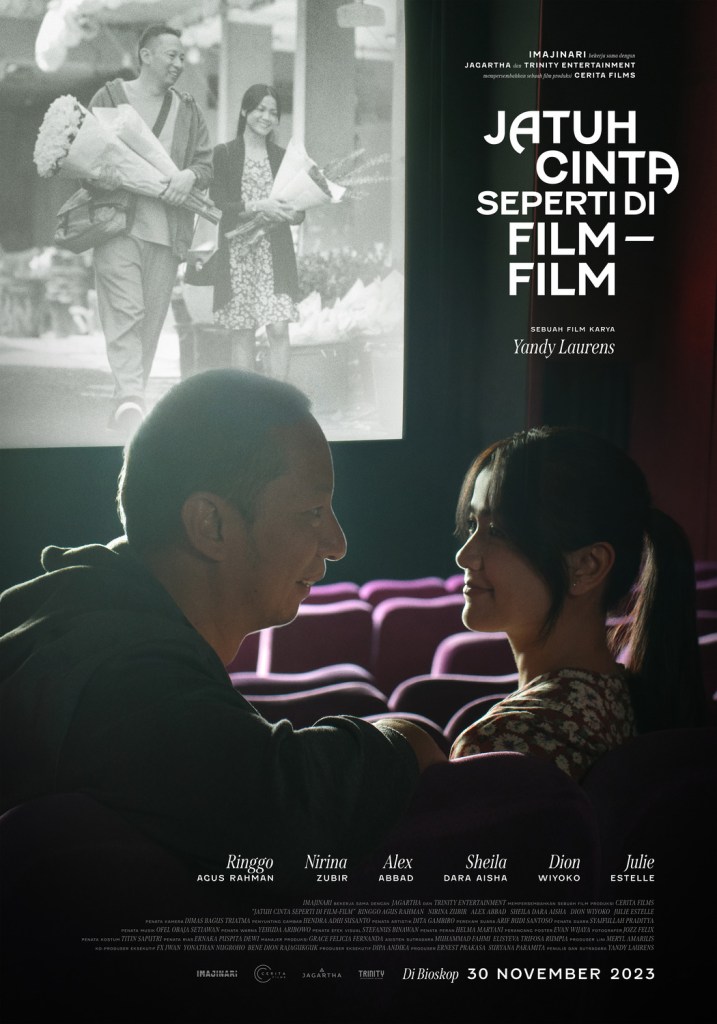
Directed by Yandy Laurens, the film begins with a premise that feels deceptively familiar: a reconnection between two people, a quiet possibility of love, and the fragile hope that something meaningful might emerge from it. Just that, it is revealed that it is not interested in telling a conventional love story. Instead, it examining not just how love is felt, but how it is imagined, constructed, and often misunderstood through the lens of cinema itself. We come into it already carrying images, expectations, and narratives that have been shaped by the countless stories we have consumed.
The main character, Bagus is a screenwriter; he is someone who knows what falling in love is supposed to look like. He recognizes the beats, the gestures, the unspoken rules that define romantic storytelling. And this awareness, rather than guiding him, becomes a kind of burden. It creates a subtle but persistent tension between what he feels and how he believes those feelings should be expressed. In this sense, the film is less about the emergence of love and more about the struggle to experience it authentically.

Hana in the other hand, is the emotional center of the story even though the film is largely framed through Bagus’ perspective. She’s not written as a typical “romantic interest,” and that’s exactly what makes her feel so real and quietly powerful. She is a character shaped by grief, and doesn’t rush her healing, doesn’t turn her into someone “ready” for love just because the narrative demands it. Instead, Hana exists in a space where life is still moving forward, while emotionally, she hasn’t fully caught up yet. She remains grounded in her own reality, which is unresolved, and deeply personal.
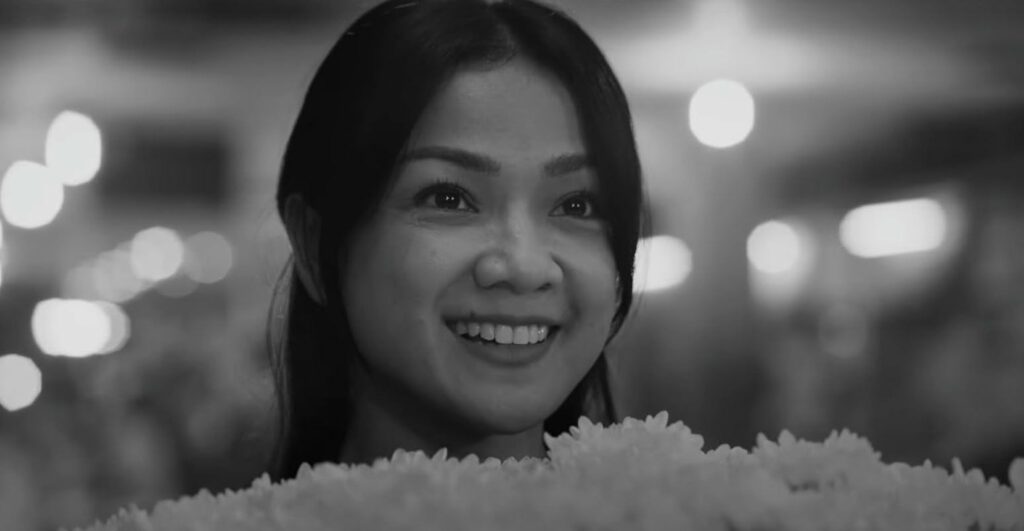
I really like the use of striking black-and-white its cinematography, beside seem purely aesthetic, and a stylistic homage to classic cinema. But it also a visual language is deeply intertwined with its thematic concerns. This distinction becomes crucial in understanding the film’s emotional landscape. There is a sense that certain moments are not just being lived, but also observed, almost as if the characters themselves are aware of how those moments might appear in a film. This self-awareness introduces a delicate layer of ambiguity.
The film rely in something deeply human: the conversations. Much of its emotional movement unfolds through dialogue, through exchanges that feel at once natural and slightly self-conscious. The conversations drift, circle back, and occasionally falter, mirroring the way people often speak when they are trying to articulate feelings that are not yet fully understood. There is a searching quality to these interactions, a sense that the characters are not simply communicating, but also discovering something about themselves in the process. At times, conversations carry a faint echo of performance, as if the characters are aware of how a romantic moment is supposed to sound.
Beneath this exploration of love and perception, lies a more profound emotional current: grief. The film does not treat grief as a dramatic event to be resolved, but as a persistent presence that shapes the way its characters move through in its world. It is subtle, often unspoken, but always there in the pauses, hesitations, in a careful way one character navigates the possibility of opening herself to someone new.
In this context, the film’s restraint is not a form of withholding, but a deliberate choice. It resists the temptation to amplify its emotions for dramatic effect, choosing instead to remain within the quiet, uncertain space where real feelings often reside. Very unusual indeed, but here, the absence of exaggeration becomes a form of sincerity. It push me as an audience to recognize the significance of small gestures, of subtle shifts, of moments that might otherwise go unnoticed.
Final Chapter: Resolution and Personal Reflection (Spoilers)
It is in its final chapter that the film’s intentions become fully clear, it offers one of the most precise and emotionally grounded resolutions in recent romantic cinema. The key lies in understanding what is being resolved. It is not simply the relationship between the characters, but the way one of them understands love itself.
The monochrome imagery does not simply evoke nostalgia; it reflects a way of seeing, a way of framing reality that is already filtered, already interpreted. It suggests that what we are witnessing is not entirely immediate, but mediated shaped by memory, by imagination, or perhaps by the act of storytelling itself
The contrast between the imagined version of events and the lived reality becomes explicit. In the “scripted” version, emotions are heightened, assumptions are made, and the narrative centers on the self on what the protagonist believes the story should be. In reality, however, something quieter and more significant occurs. There is a shift from interpretation to listening, from projection to presence. Bagus learns that love is not something as he has written, but something to be experienced in its own terms.
The film offers something rarer: a resolution that feels earned because it reflects a genuine shift in understanding. It suggests that love, at its most meaningful, is not about fulfilling expectations, but about learning how to meet another person where they are. It is not marked by a grand declaration or a dramatic culmination, but by a change in perspective. The act of asking, of giving space, of allowing the other person to exist outside the framework of a predetermined narrative. When affection is expressed, it is done without excess, without the need for cinematic flourish. And when it is received, it is met with a quiet acceptance that feels more powerful for its simplicity.
In my own personal opinion, the film left me with a lingering sense of recognition. It made me aware of how often we approach our own lives as if they were stories that we repeat in out head, how we anticipate certain moments, rehearse certain conversations, and hope for outcomes that align with what we have seen before. It reminded me that this tendency, while natural, can sometimes create distance between us and the reality we are trying to experience. And it suggested, gently but firmly, that perhaps the most honest way to love is to let go of the script and to allow ourselves in that moments.

There is a quiet, almost unassuming line in Jatuh Cinta Seperti di Film-Film that lingers long after the film ends: “Yang paling berat dari berduka adalah hidup jalan terus, padahal kitanya lagi gak pengen jalan.” The hardest part about grieving is that life keeps moving, even when we no longer want to move with it. It is not delivered with dramatic emphasis, nor framed as a defining cinematic moment, and yet it carries the emotional weight of the entire film. In many ways, it becomes the key through which everything else can be understood, not just the romance, but the hesitations, the silences, and the peculiar rhythm with which the film unfolds.
For me, Jatuh Cinta Seperti di Film-Film is a redefinition of romance. It does not argue that love is less meaningful than the stories we tell about it; rather, it proposes that it is meaningful in a different way, which is quieter, less certain, but no less profound. It is a film that chooses to step outside allure of cinematic love, to explore what remains when the performance is stripped away. And what remains, as the film so beautifully suggests, is something simple, fragile, and deeply human.





Leave a comment